Why does my room get dusty so fast is not simply a matter of poor cleaning habits, but a result of continuous environmental input combined with structural conditions that allow particles to accumulate faster than they are removed.
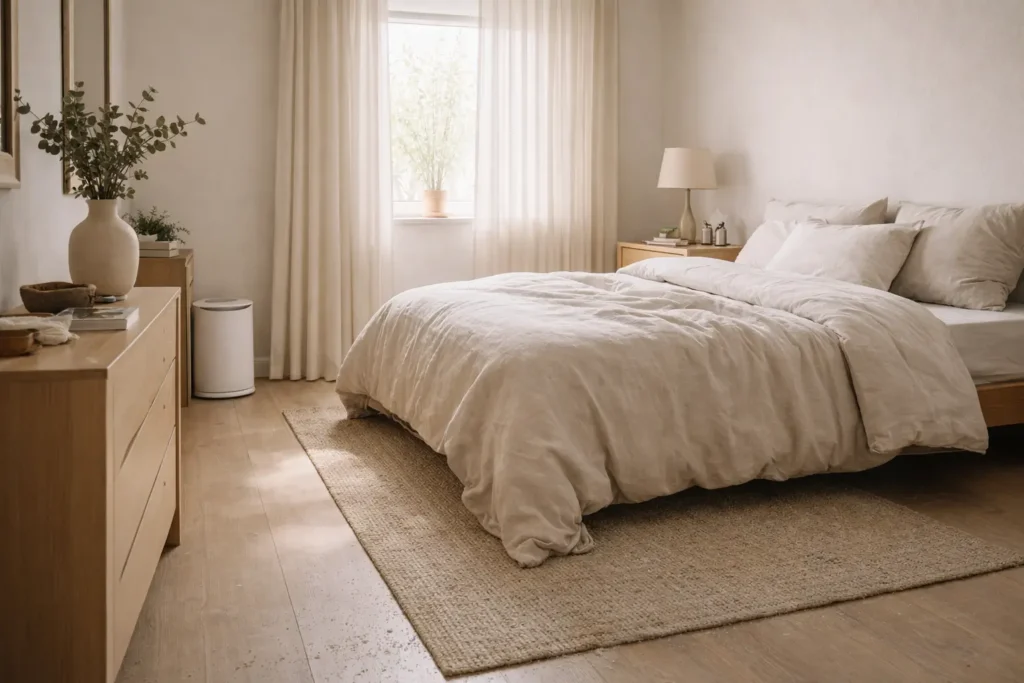
Dust does not appear suddenly. It is constantly entering, settling, and redistributing within a space. What makes one room seem dustier than another is not just how often it is cleaned, but how effectively it manages this ongoing flow.
Understanding this requires shifting from a cleaning perspective to a system perspective.
The Continuous Input Cycle of Dust
Dust accumulation is driven by a constant inflow of microscopic particles rather than isolated events.
These particles come from multiple sources:
- Fabric fibers from clothing and furniture
- Skin cells released naturally
- Outdoor particles entering through air movement
- Residue from everyday activities
This constant input cycle behaves similarly to other buildup patterns inside the home, particularly those related to airflow and surface exposure. A comparable dynamic can be observed in why does my bathroom smell like sewage, where system imbalance allows unwanted elements to persist instead of being contained.
Because this input never stops, dust is always forming, even in recently cleaned environments.
The key factor is not whether dust enters the room—but how the environment handles it once it does.
Why Does My Room Get Dusty So Fast Compared to Other Spaces
Rooms accumulate dust at different rates depending on how air, surfaces, and usage patterns interact.
Several structural differences explain this variation:
Airflow Patterns
Rooms with higher air movement bring in more external particles.
Fabric Density
Spaces with carpets, curtains, or upholstered furniture trap and release fibers continuously.
Surface Exposure
Flat, open surfaces allow dust to settle more easily and visibly.
Cleaning Distribution
If some areas are cleaned less frequently, they act as reservoirs that redistribute particles.
This explains why two rooms in the same home can behave very differently.
Hidden Mechanisms Behind Rapid Dust Accumulation
Dust buildup is often influenced by mechanisms that are not immediately visible.
Static Electricity
Certain materials attract and hold particles, increasing accumulation on surfaces.
Air Turbulence
Movement within a room—walking, opening doors—keeps particles circulating before they settle again.
Layered Settling
Dust does not settle evenly. It accumulates in layers, often concentrating in specific zones.
Micro-Redistribution
Each time a surface is disturbed, particles become airborne again and resettle elsewhere.
These mechanisms create the perception that dust “returns quickly,” when in reality it never fully left.
The Role of Behavioral Patterns in Dust Perception
Dust accumulation is partly physical, but perception plays a major role.
Small behaviors influence how quickly dust becomes noticeable:
- Delaying cleaning cycles
- Prioritizing visible areas only
- Allowing surfaces to accumulate gradually
- Disturbing dust without fully removing it
These actions create a pattern where dust appears to return faster than expected.
In many cases, it is not increasing—it is simply becoming more visible.
Accumulation Zones and Structural Imbalance
Dust rarely distributes evenly across a room.
Instead, it concentrates in specific areas:
- Near entry points
- Around frequently used furniture
- On horizontal surfaces
- In corners with limited airflow
These zones act as accumulation centers.
When not addressed, they release particles back into the environment, reinforcing the cycle.
These zones act as accumulation centers. When not addressed, they release particles back into the environment, reinforcing the cycle. This pattern is structurally similar to recurring organizational issues, as explored in why clutter keeps coming back, where small imbalances lead to repeated accumulation over time.
Why Cleaning Alone Does Not Solve the Problem
Cleaning removes visible dust but does not stop the system that produces it.
If the underlying conditions remain unchanged:
- Dust continues to enter
- Particles continue to circulate
- Accumulation resumes immediately
This limitation reflects a broader pattern in household systems, where repeated actions fail to create stability. A related example can be seen in why does laundry pile up so fast, where accumulation is driven by continuous input rather than isolated events.
This creates a cycle where cleaning becomes repetitive without producing lasting results.
The limitation is not the effectiveness of cleaning, but the absence of structural control over input and redistribution.
Recalibrating the Environment to Reduce Dust
Reducing dust accumulation requires small structural adjustments rather than more frequent cleaning.
Managing Air Entry
Limiting uncontrolled airflow reduces external particle input.
Adjusting Material Surfaces
Reducing fabric-heavy elements lowers fiber release.
Controlling Surface Exposure
Minimizing open horizontal areas reduces settling points.
Improving Cleaning Sequence
Cleaning high-to-low prevents redistribution.
Maintaining Consistency
Short, regular cleaning cycles prevent buildup from reaching visible levels.
These adjustments do not eliminate dust, but they slow the rate of accumulation significantly.
The Compounding Effect of Small Inefficiencies
Dust accumulation is a compounding process.
Each small inefficiency contributes:
- Slight delays in cleaning
- Minor airflow imbalances
- Small areas left untreated
Individually, these factors seem insignificant. Together, they accelerate accumulation.
This is why dust often appears to increase suddenly—it has been building gradually.
Conclusion
Dust does not accumulate quickly because of a single cause, but because of a continuous system that allows particles to enter, circulate, and settle without interruption.
When airflow, surfaces, and behavior are misaligned, accumulation becomes more visible and more frequent.
The solution is not to clean more often, but to adjust the environment so that it produces less accumulation in the first place.
By reducing input, limiting redistribution, and stabilizing the system, it is possible to slow the cycle and maintain a cleaner space with less effort.