Why laundry piles up so fast is rarely caused by a single factor, but rather by a combination of behavioral patterns, invisible system gaps, and delayed feedback cycles that accumulate over time.
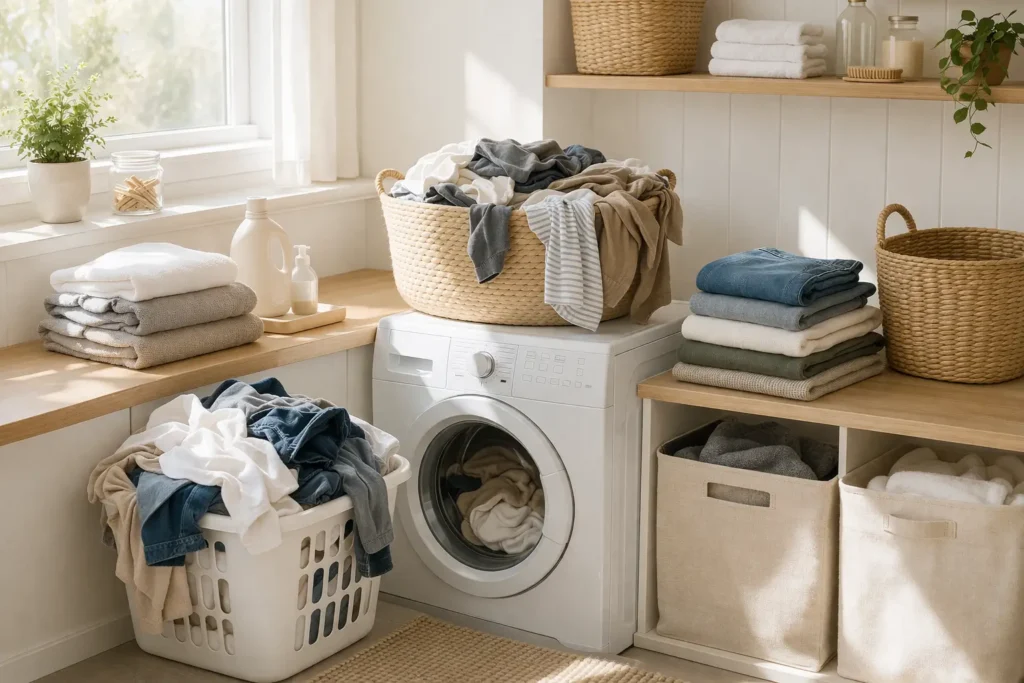
In most households, laundry does not become overwhelming overnight. Instead, it builds gradually through small, repeated inefficiencies that go unnoticed until they reach a visible threshold. What appears to be a simple backlog is often the result of structural misalignment between usage, capacity, and routine timing.
Understanding this dynamic requires shifting from a task-based perspective (“doing laundry”) to a systems-based view that examines how and why accumulation happens in the first place.
The Perception Gap Between Use and Maintenance
One of the primary reasons laundry builds up is the disconnect between how frequently items are used and how infrequently they are processed.
Clothing, towels, and linens follow a continuous usage cycle, but washing tends to happen in isolated batches. This creates a mismatch where input (used items) is constant, while output (clean laundry) is intermittent.
Over time, this imbalance produces accumulation.
In practical terms:
- Clothes are worn daily
- Towels are reused but still accumulate
- Laundry cycles are delayed until “enough” exists
This delay-based system introduces friction. Instead of maintaining flow, it encourages buildup. Many households reduce this friction by integrating small daily behaviors that keep accumulation under control. You can see how this works in practice in this guide on daily habits that keep your home organized, which explains how consistent actions prevent small issues from compounding.
Hidden Structural Factors Behind Laundry Accumulation
Laundry rarely piles up due to laziness or lack of discipline. More often, it reflects structural inefficiencies within the household system.
Several underlying factors contribute to this pattern:
1. Lack of Defined Processing Frequency
Without a fixed rhythm, laundry becomes reactive. It is triggered by volume rather than schedule.
2. Overloaded Batch Thinking
Waiting for a “full load” increases efficiency per cycle but reduces consistency, leading to accumulation spikes.
3. Friction in Execution
If the process involves multiple steps—sorting, transporting, drying, folding—each added layer increases resistance.
4. Capacity Mismatch
The volume of laundry generated exceeds the realistic capacity of available time and energy.
When combined, these factors create a system where accumulation is not only possible but inevitable.
Why Laundry Piles Up So Fast in Daily Life Systems
The speed at which laundry builds up is directly linked to compounding behavior.
Each small delay introduces a carryover effect:
- Skipping one day increases the next load
- Larger loads require more time
- Increased effort leads to further postponement
This creates a feedback loop:
Delay → Increased Volume → Higher Effort → More Delay
Over time, this loop accelerates accumulation.
Unlike visible mess, laundry often remains partially hidden (in baskets, machines, or piles), which reduces urgency and allows the cycle to continue longer than other household disruptions.
The Role of Cognitive Load in Laundry Backlog
Laundry is not just a physical task—it is also a cognitive one.
Each stage requires decisions:
- When to start
- What to wash together
- Whether there is enough time to finish
These micro-decisions create mental load.
When cognitive load is high (busy schedules, multiple responsibilities), tasks that require sequential steps—like laundry—are more likely to be delayed.
This explains why laundry often piles up even in otherwise organized homes.
It is not the task itself, but the mental overhead associated with initiating and completing it.
Accumulation Thresholds and Delayed Visibility
Laundry has a unique characteristic compared to other household tasks: delayed visibility.
A sink full of dishes demands immediate attention. Laundry, however, can accumulate gradually without creating immediate disruption.
This creates a threshold effect:
- Below a certain volume → ignored
- Above a certain volume → overwhelming
Once this threshold is crossed, the perceived effort increases significantly, making it harder to start.
This is why laundry often shifts suddenly from manageable to excessive.
Recalibrating the System to Prevent Recurrence
Reducing laundry buildup is less about working harder and more about adjusting the system that governs it.
Effective recalibration focuses on flow rather than volume.
Key adjustments include:
Establishing Fixed Processing Intervals
Instead of waiting for accumulation, define consistent washing days or cycles.
This structured approach aligns with broader routines used in home organization systems. A practical example can be found in this weekly home organization checklist, which shows how distributing tasks across the week reduces accumulation pressure.
Reducing Batch Size
Smaller, more frequent loads maintain continuity and reduce resistance.
Minimizing Process Friction
Simplify steps:
- Use fewer sorting categories
- Keep supplies accessible
- Streamline transitions between stages
Aligning Capacity With Reality
Match laundry frequency to actual lifestyle demands, not ideal expectations.
These changes shift laundry from a reactive task to a stable system.
Behavioral Patterns That Reinforce the Cycle
Certain habits unintentionally reinforce accumulation:
- Saving items “for later washing”
- Avoiding partial loads
- Prioritizing other visible tasks first
These patterns create a bias toward postponement. Over time, this behavior mirrors broader organizational issues where disorder repeatedly returns even after being addressed. This pattern is explored in more detail in why does clutter keep coming back, which explains the underlying behavioral cycles that sustain recurring buildup.
Breaking the cycle requires recognizing that consistency, not efficiency per load, is what maintains system stability.
Conclusion
Laundry accumulation is not a simple matter of neglect—it is the result of structural, behavioral, and cognitive factors interacting over time.
When usage patterns, processing frequency, and system design are misaligned, buildup becomes inevitable.
The solution is not to increase effort, but to restore flow.
By reducing friction, adjusting frequency, and aligning capacity with real-life conditions, laundry can shift from a recurring problem into a stable, predictable system.